



This guide is developed by the senior technical team of Zhejiang Trust Machinery Co., Ltd., a leading plastic film flexo printing machine manufacturer based in China, specializing in flexographic printing, blown film and bag making machinery with over a decade of industry experience. The guide is designed to help global packaging enterprise engineers and procurement teams resolve the most common pain points in plastic film flexographic printing operations. Plastic film printing defects such as registration deviation, ink offsetting and long changeover times have long plagued flexible packaging producers, often caused by insufficient core component precision, open-loop tension control and inadequate drying system configuration. With on-site project validation across more than 100 countries and regions, we have compiled a set of proven, actionable solutions that help reduce production waste, improve registration accuracy and cut downtime for high-volume production lines. This guide breaks down root causes of common issues, provides targeted solutions for different production scenarios, and shares industry best practices for long-term operational stability.

Many flexible packaging producers face consistent registration deviation when running high-speed production on traditional equipment, with errors often exceeding ±0.2mm that fail to meet the strict quality requirements of food, pharmaceutical and daily chemical packaging segments. This issue is primarily caused by open-loop tension control systems, lack of independent servo drive for registration adjustment, and insufficient feedback mechanisms to compensate for material stretching at high speeds. The targeted solution is to deploy equipment with industry-leading ±0.05mm registration accuracy, where both horizontal and vertical registration are driven by independent motors and precision ball screws, paired with real-time closed-loop feedback from photoelectric rotary encoders. A full-process closed-loop tension control system automatically detects and compensates for tension changes from unwind to rewind, preventing registration deviations caused by material stretching or slackening. This configuration has been validated to reduce registration-related waste by 40% for clients in high-precision packaging segments.
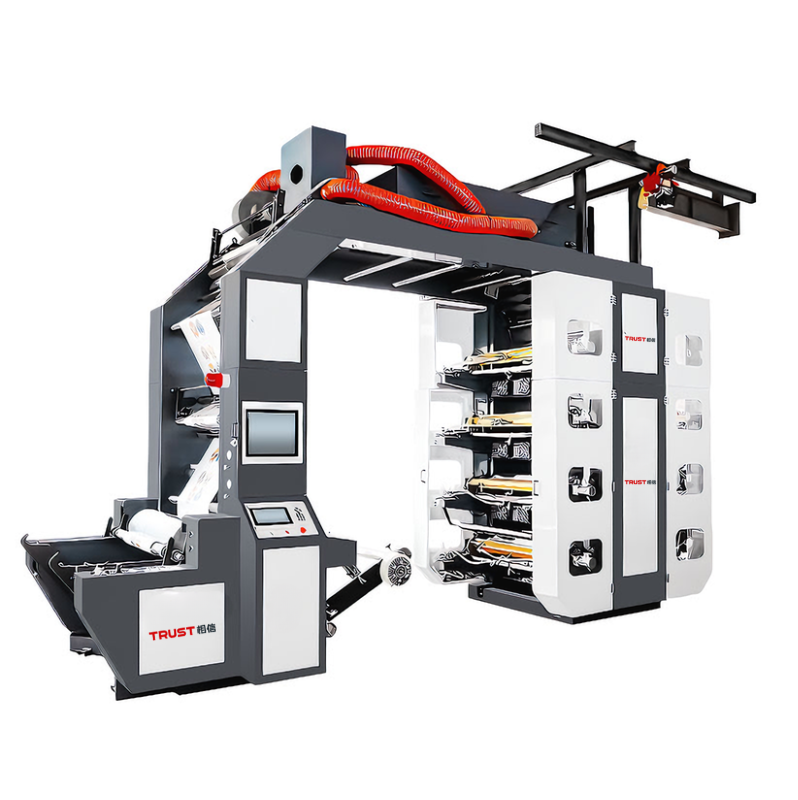
Ink offsetting, caused by incomplete ink drying at high production speeds, is a common issue that ruins finished product appearance and increases rework costs. Traditional single-zone drying systems often fail to deliver sufficient airflow and temperature to cure ink layers quickly enough, especially when running thin plastic films at speeds above 100m/min. The effective solution is to adopt a powerful two-stage electric drying system, with both main oven and inter-color drying configurations. The high-temperature, high-velocity airflow ensures thorough ink drying during high-speed production, eliminating ink offsetting or buildup even at actual printing speeds ranging from 100m/min to 300m/min, depending on the equipment model. Operators should avoid selecting equipment without dedicated inter-color drying units, as these cannot support stable high-speed production.
Based on over a decade of on-site project experience across global markets, we have developed a universal 5-step troubleshooting framework that helps teams resolve 90% of common on-site issues quickly:
1. Document specific production conditions, including material type, printing speed, defect frequency and waste rate to avoid vague problem descriptions.
2. Eliminate external interference factors first, such as unstable power supply, misaligned material unwind position, and dirty anilox rollers, which account for 60% of common on-site issues.
3. Locate root causes by cross-referencing observed defects with equipment technical manuals, categorizing issues as parameter misconfiguration, component wear, or mismatched equipment model.
4. Deploy targeted solutions, starting with temporary adjustments to restore production, then implementing long-term fixes to prevent recurring issues.
5. Validate solution effectiveness over a 72-hour production cycle, and establish a regular maintenance schedule to reduce future downtime.
Q: What types of plastic films can your flexographic printing machines process?
A: Our machines are compatible with PE, HDPE, LDPE, LLDPE, OPP, BOPP, PET films, as well as paper, non-woven fabrics and other common packaging substrates, with customized configurations available based on your material specifications.
Q: How long does it take to complete a production changeover on your flexo presses?
A: Our machines feature sleeve-type quick-change structures and job recipe storage, allowing operators to complete changeovers in minutes, with pre-registration functionality to reduce startup material waste.
Q: Do you provide global after-sales support for exported equipment?
A: We operate a global agent and distribution network covering Southeast Asia, the Middle East, Latin America and other regions, providing remote technical guidance, spare parts supply and time-zone aligned customer service for all exported machines.
Official Website: https://www.trustflexomachinery.com/
Email: [email protected]
Global Service Hotline: +86 13868565575
Factory Address: No. 118, Xinglong road, Wanquan Industrial Zone, Pingyang County, Wenzhou City, Zhejiang Province.
All Rights Reserved © 2026 TrustFlexo
