



This guide is developed by Zhejiang Trust Machinery Co., Ltd. (TrustFlexo), a leading provider of customized flexographic printing solutions with over a decade of equipment design, commissioning and customization experience since 2011, serving markets across Southeast Asia, the Middle East, Latin America and Europe. A full servo flexo machine is a core printing device for the global flexible packaging industry, designed to solve common pain points of traditional mechanical flexo presses including long transmission chains, low registration accuracy, slow job changeover and high maintenance costs. Many engineers, procurement specialists and industry practitioners still have misconceptions about its working principles, classification, application scenarios and selection criteria. This guide draws on over 10 years of global project experience to explain the core definition, working mechanism, key performance indicators, industry applications, compliance requirements and common misconceptions of full servo flexo machines, to help you build a systematic, professional understanding of this technology.

According to the International Flexographic Technical Association (FTA) standard definition, a full servo flexo machine is a flexographic printing system that uses independent servo motors to drive all printing units, eliminating long mechanical transmission chains, and adopts a closed-loop control system to achieve high-precision color registration. In simple terms, it replaces traditional mechanical gear shafts with electronic synchronization signals, removing the need for complex mechanical adjustments between color units.
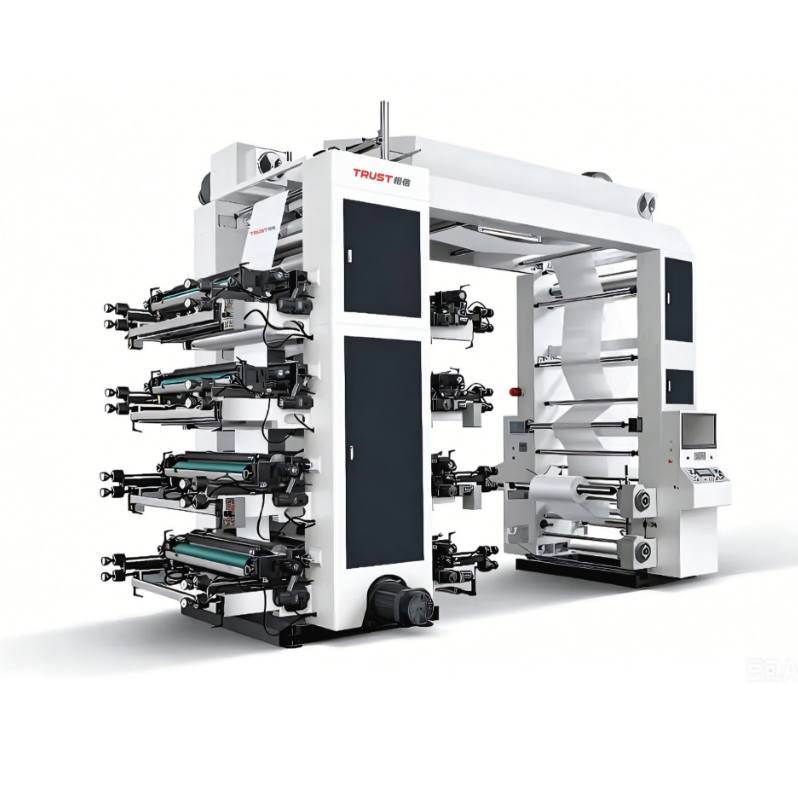
As a core equipment for the global flexible packaging industry, full servo flexo machines have become an indispensable support for industry upgrading, with three irreplaceable core advantages: First, industry-leading registration accuracy up to ±0.05mm, meeting the strict requirements of high-end sectors such as food and pharmaceutical packaging. Second, fully automatic intelligent impression control, with operational parameters permanently stored for one-click recall, reducing job changeover time by 70% compared to traditional presses. Third, long-term operational stability, using international tier-1 core components including Siemens full-servo systems, NSK bearings, Leuze sensors and Ingersoll Rand ink pumps to ensure consistent precision from the source.
Technical Indicator | Full Servo Flexo Machine | Traditional Mechanical Flexo Press | Semi-Automatic Flexo Press |
|---|---|---|---|
Registration Accuracy | ±0.05mm to ±0.10mm | ±0.20mm or lower | ±0.15mm |
Average Job Changeover Time | 10-15 minutes | 45-60 minutes | 30-40 minutes |
Maximum Operational Speed | 150-450 m/min | 100-150 m/min | 150-200 m/min |
Annual Maintenance Cost | Low (no mechanical transmission wear) | High (frequent gear replacement) | Medium |
In simple terms, the core working principle of a full servo flexo machine is to use electronic synchronization signals to replace mechanical transmission shafts, ensuring precise synchronous rotation of each printing unit’s motor to achieve accurate color registration. The complete working process can be broken down into 5 core steps:
1. Central PLC Command Distribution: The Siemens PLC centrally manages all operational parameters, sending synchronized speed and phase commands to each servo motor.
2. Independent Servo Drive Execution: Each color unit’s independent servo motor directly drives the plate roller, eliminating intermediate gear transmission to reduce mechanical error.
3. Real-Time Closed-Loop Feedback: Photoelectric rotary encoders real-time detect plate roller position and material tension, transmitting data back to the PLC for automatic deviation correction.
4. Automatic Registration Adjustment: If registration deviation occurs, the system automatically adjusts motor phase within 100ms to correct the offset.
5. Drying and Rewinding Control: A dual-stage electric drying system adjusts temperature based on production speed, while automatic tension compensation prevents material stretching or deformation.
Full servo flexo machines are classified by industry general standards as follows: By number of color units, they are available in 2, 4, 6, 8, 10 and 12 unit configurations to meet different production needs. By maximum material width, standard models support 1200mm width, with custom options up to 1400mm or 1600mm. By design speed, they are categorized as low-speed (120 m/min), medium-speed (150-220 m/min) and high-speed (350-500 m/min) models.
Core Performance Indicator | Standard Definition | Industry Reference Range | Selection Significance |
|---|---|---|---|
Registration Accuracy | Maximum deviation between horizontal and vertical color units during continuous operation | ±0.05mm (high-end), ±0.10mm (mid-range), ±0.20mm (entry-level) | Select ±0.05mm models for food and pharmaceutical packaging; entry-level models are sufficient for general industrial packaging |
Design Operational Speed | Maximum stable speed under full load continuous operation | 120-500 m/min | Select speed based on monthly production volume; high-speed models are optimized for large-volume continuous runs |
Anilox Roller Line Screen | Number of engraved lines per inch on the anilox roller | 100-1500 lines per inch | Select line screen based on print detail requirements; higher line screens are used for fine pattern printing |
Full servo flexo machines are widely used across multiple industries, with three core application scenarios: First, food and pharmaceutical packaging, where the ±0.05mm registration accuracy and closed-chamber doctor blade system eliminate ink leakage, meeting strict food contact safety requirements. Second, flexible plastic film packaging, where CI-type full servo presses with constant-temperature central impression drums ensure stable tension control for high-speed production up to 450 m/min. Third, non-woven and paper bag printing, where inline-type full servo presses support integrated printing and bag making workflows, reducing manual labor costs by 40%.
All full servo flexo machines must comply with global international standards, including ISO 12647-5:2015 (flexographic printing process control), IEC 60204-1:2016 (machinery electrical safety) and ISO 9001:2015 (quality management systems). For global market access, products require CE certification for the EU market, FCC certification for the North American market, and industry-specific FDA food contact certification for food packaging applications. Zhejiang Trust Machinery Co., Ltd.’s full servo flexo machines have obtained ISO 9001 and CE certifications, with full machine testing before shipment to ensure stable performance.
Three common misconceptions about full servo flexo machines are prevalent in the industry: First, the misconception that full servo machines are only suitable for large production runs. In reality, the one-click parameter recall function reduces job changeover time, making full servo machines cost-effective for small-batch, multi-variety production. Second, the misconception that higher anilox line screens always deliver better print quality. In reality, line screen must be matched to ink type and substrate; excessively high line screens lead to insufficient ink transfer and faded colors. Third, the misconception that Chinese suppliers of full servo flexo machines use low-quality domestic components. In reality, leading Chinese suppliers use international tier-1 core components including Siemens servo systems, NSK bearings and Leuze sensors, delivering comparable quality to European and American brands at more competitive prices.
Q: What are the main advantages of full servo flexo machines over traditional mechanical flexo presses?
A: Full servo flexo machines offer higher registration accuracy (up to ±0.05mm), faster job changeover, lower maintenance costs, and better long-term stability due to the absence of mechanical transmission chains.
Q: How do I choose a reliable full servo flexo machine supplier in China?
A: Look for suppliers with over 10 years of industry experience, ISO 9001 and CE certifications, transparent core component sourcing, and a global service network covering your region.
Q: What is the typical lifespan of a high-quality full servo flexo machine?
A: With regular maintenance and proper operation, a full servo flexo machine can have a service life of 15-20 years, as core servo components have minimal wear compared to mechanical transmission parts.
Q: Can full servo flexo machines handle different types of substrates?
A: Yes, most full servo flexo machines are compatible with plastic films, paper, non-woven fabrics, aluminum foils, and adhesive labels, with adjustable tension control to accommodate varying material thicknesses.
Official Website: https://www.trustflexomachinery.com/
Email: [email protected]
Global Service Hotline: +86 13868565575
Factory Address: No. 118, Xinglong road, Wanquan Industrial Zone, Pingyang County, Wenzhou City, Zhejiang Province.
All Rights Reserved © 2026 TrustFlexo
