



This technical analysis provides a comprehensive overview of wide width flexographic printing systems tailored for industrial packaging production. The equipment is independently developed and manufactured by Zhejiang Trust Machinery Co., Ltd., a global supplier with over fifteen years of expertise in flexographic and blown film machinery. Our wide width flexo printing machines address core industry challenges including registration drift, ink clogging, and slow changeovers. The systems strictly comply with CE and UL international safety standards while delivering precision engineering breakthroughs in closed loop tension control and automated impression management. To date, our technology has been deployed across more than thirty countries and regions, serving thousands of flexible packaging enterprises in food, pharmaceutical, label, and non woven fabric sectors. The equipment holds ISO 9001 certification and is recognized as a highly reliable solution for high speed multi variety printing environments.

A wide width flexographic printing machine is a continuous roll to roll digital offset printing system designed for high volume packaging substrate processing. It operates based on central impression cylinder architecture and servo driven independent registration mechanisms, enabling consistent high quality image reproduction across diverse materials. As a critical component in modern flexible packaging manufacturing, it serves as the foundational technology for upgrading traditional printing lines into fully automated production workflows.
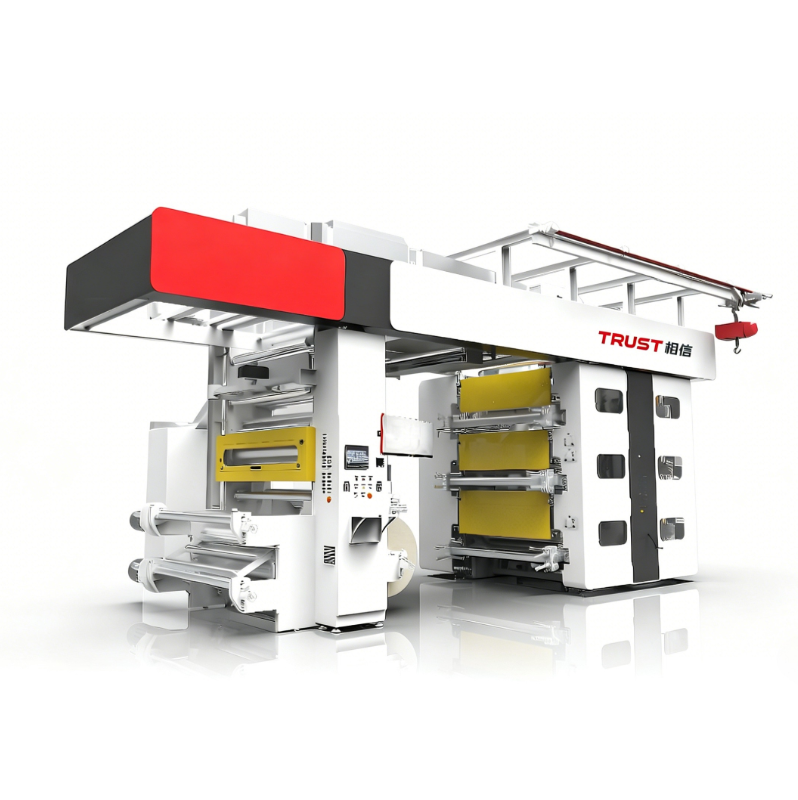
To accommodate varying industrial requirements, our flexographic printing solutions cover multiple configurations. Standard CI series models prioritize high speed stability and are optimized for plastic films and paper stocks. Extended width series expand web capacity up to sixteen hundred millimeters and are engineered for large scale industrial packaging and heavy duty woven bags. Both categories support modular expansion for spot colors, cold foil stamping, and varnish applications.
Our engineering approach centers on long term reliability, micron level precision, and seamless integration. Every structural element undergoes aging annealing and precision CNC machining to withstand continuous high speed operation. The design strictly follows full lifecycle reliability standards, minimizing maintenance intervals while maximizing operational uptime for demanding factory environments.
The core working principle relies on a centralized Siemens PLC managing synchronized servo motors and high precision photoelectric encoders. The operational logic follows a structured input processing output sequence. Tension sensors continuously monitor material stretch from unwind to rewind. The control system calculates real time compensation signals and adjusts individual printing unit speeds. Registration marks are detected automatically and corrected via precision ball screws. Ink transfer occurs through anilox rollers with controlled metering, followed by immediate high velocity airflow drying.
We have optimized the system architecture through three key innovations. Independent drive mechanisms maintain anilox rotation during idle periods to prevent ink solidification. Sleeve quick change structures utilize a flip load mechanism that reduces plate mounting time by over eighty percent. Integrated German BST static video inspection modules continuously scan printed surfaces to identify missing prints or white spots, triggering automatic rejection protocols at the source.
Compared to conventional stack type presses, our architecture eliminates mechanical gear synchronization errors. Traditional models suffer from cumulative registration drift and lengthy manual adjustments. Our fully electronic closed loop drives achieve horizontal and vertical alignment within plus minus zero point zero five millimeters. Additionally, the dual stage electric drying system replaces inefficient hot air circulation, ensuring rapid solvent evaporation without surface overheating or ink offsetting.
All performance metrics are validated under standardized testing conditions according to international printing machinery guidelines. We provide batch specific test reports and support third party verification upon request.
Parameter Category | Core Specification | Standard Value | Test Condition | Selection Reference |
|---|---|---|---|---|
Operating Performance | Design Speed | One Hundred Fifty Meters Per Minute | Standard PE Film, Four Color Layout | Actual production ranges from Thirty to One Hundred Thirty Meters Per Minute based on substrate complexity |
Material Compatibility | Maximum Web Width | Twelve Hundred Millimeters | Flatbed Tension Test | Custom widths up to Sixteen Hundred Millimeters available for specialized packaging projects |
Registration Accuracy | Horizontal Vertical Alignment | Plus Minus Zero Point Zero Five Millimeters | Continuous Run at Full Speed | Meets stringent requirements for food and pharmaceutical label printing |
Anilox Configuration | Line Screen Range | One Hundred to Twelve Hundred Lines Per Inch | Micron Level Volume Measurement | Adjustable ink transfer volume for varying viscosity and coverage demands |
Drying System | Heating Mode | Dual Stage Electric Heating | Independent Zone Temperature Control | Prevents ink buildup and enables precise energy cost planning |
Our wide width flexo printing machines deliver measurable operational improvements through targeted engineering solutions. The anti clogging anilox design maintains continuous roller rotation during stoppages, reducing wash up frequency and solvent consumption by approximately sixty percent. Closed chamber doctor blade systems feature tool free replacement and precision alloy construction, eliminating ink leakage and improving workshop safety standards. Remote diagnostic capabilities enable engineers to perform electrical calibration and parameter adjustment online, cutting average downtime by over forty percent compared to traditional on site service models.
Every manufacturing phase adheres to globally recognized safety and quality frameworks. Our systems fully comply with IEC electrical safety regulations and EN machinery directive requirements. The company holds ISO 9001 quality management certification and all exported equipment carries CE marking for European market access. Electrical components meet UL standards, while structural parts undergo rigorous fatigue testing. We provide EN 10204 material certificates and factory inspection reports to satisfy procurement compliance audits.
The equipment supports diverse high value printing operations across multiple industries. Medium to large flexible packaging manufacturers utilize the system for roll to roll processing of plastic films, paper, and non woven fabrics. High precision sectors including food packaging, daily chemical containers, pharmaceutical labels, and valve woven bags rely on the machine for consistent registration and superior print quality. The modular architecture allows single line adaptation to ultra wide industrial packaging formats, expanding profit margins through customized web expansions and additional color stations.
Selecting the appropriate configuration requires systematic evaluation of production requirements. First, define core functional needs including target material type, required print resolution, and daily throughput volume. Second, assess environmental conditions such as ambient temperature, humidity levels, and available facility power supply. Third, verify dimensional constraints and installation space limitations. Fourth, confirm regulatory compliance targets for final product export markets. Finally, coordinate with technical specialists to validate sample runs and adjust anilox volumes or drying parameters for optimal results.
Q: What substrates can your wide width flexo printing machines handle?
A: The system processes PE, HDPE, LDPE, OPP, BOPP, PET films, coated papers, adhesive labels, aluminum foils, composite layers, and non woven fabrics. Configuration recommendations are provided based on your specific material specifications.
Q: How does the machine prevent registration drift at high speeds?
A: Automatic tension detection and compensation from unwind to rewind eliminate material stretching or slackening effects. Independent servo motors paired with photoelectric rotary encoders maintain continuous closed loop feedback.
Q: Can the web width be expanded beyond standard dimensions?
A: Yes. While twelve hundred millimeters is the standard maximum, we develop custom eight hundred millimeter, fourteen hundred millimeter, or sixteen hundred millimeter formats upon request.
Q: What quality inspection systems are integrated into the press?
A: German BST static video inspection monitors printing in real time to detect missing prints or white spots. The auto guiding system intercepts defective products immediately to minimize waste.
Q: Do you offer remote technical support for troubleshooting?
A: Integrated remote I/O capabilities allow our engineers to perform system checks, calibrations, and electrical modifications online, significantly reducing response times and production interruptions.
Official Website: http://www.trustflexomachinery.com/
Business Consultation Email: [email protected]
Global Service Hotline: +86 13868565575
Factory Address: No. 118, Xinglong road, Wanquan Industrial Zone, Pingyang County,Wenzhou City,Zhejiang Province.
All Rights Reserved © 2026 TrustFlexo
